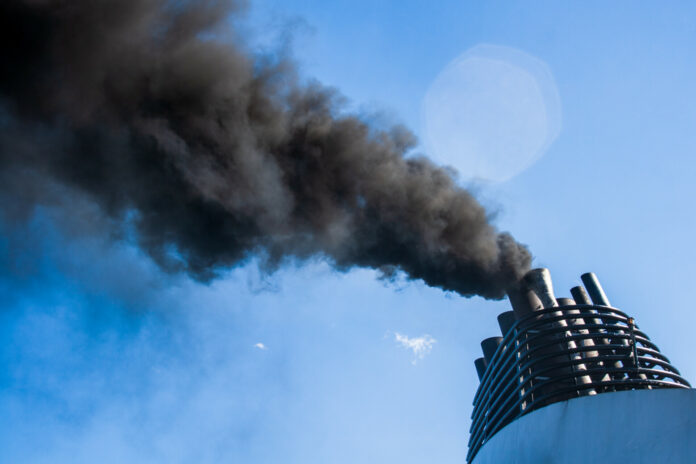
A Norwegian classification society's research indicates that the cost burden will be shifted to consumers.
The process of decarbonising will lead to a massive increase in operating costs for shipping companies, according to a study by the Norwegian classification society DNV.
Achieving the International Maritime Organization's (IMO) final and intermediate emission reduction targets will result in a significant rise in cost per ton-mile compared to usual operations.
"Increased freight rates will need to be passed along the value chain, with consumers likely bearing the majority of the cost," notes DNV’s Shipping CEO, Knut Orbeck-Nilssen, in the introduction to the annual report "Maritime Forecast to 2050."
The Norwegian classification society measured the total cost across three main shipping sectors (containerships, bulkers, and tankers), including capital expenditures on ships and onboard technologies, operational costs, CO2 prices, and fuel costs.
The assessment was based on four scenarios using different alternative fuels compared to the "business-as-usual" model.
By 2050, the expected cost increase across the four scenarios is 69%-75% for bulk carriers, 70%-86% for tankers, and 91%-112% for containerships.
Examining scenarios for achieving IMO targets by 2030, 2040, and 2050, DNV estimates that the range of cost increase per ton-mile will be 16-40%, 56-71%, and 71-85% respectively.
Containerships are expected to be hit hardest compared to tankers and bulk carriers.
The Four Scenarios
DNV outlines four different decarbonisation pathways, each focusing on a specific fuel or technology:
Biofuels: The first scenario considers the dominance of biofuels combined with carbon capture and storage (CCS) systems. There is significant availability of sustainable biomass for producing bio-MGO, bio-LNG, and biomethanol for shipping, with moderate periodic price increases. CCS industry and infrastructure developments onshore will make these systems available for ships by 2030.
Methanol: The second scenario focuses on methanol. Due to economies of scale in production and transport, bio-methanol achieves lower production costs than bio-MGO and bio-LNG, which face higher prices due to demand. The e-methanol will eventually be the lowest-cost carbon-neutral methanol production route.
Ammonia: The third scenario centres on ammonia. Ammonia is used as an energy carrier for long distances across various industries, with high volumes of sea transport. Ships using ammonia as fuel drive technological improvements in engines, ammonia tanks, and fuel cells, as well as infrastructure development. Rapid decarbonisation of onshore power generation leads to an excess of low-cost renewable or nuclear electricity, with ammonia used as an energy carrier.
Hydrogen: The fourth and final scenario involves hydrogen. Rapid decarbonisation of onshore power generation results in an excess of low-cost renewable or nuclear energy, with hydrogen used as an energy carrier. Significant sea transport of liquefied molecular hydrogen is driven by industries using hydrogen on a large scale. Ships using hydrogen as fuel drive technological advancements in fuel cells and hydrogen tanks. Improvements and increased adoption of fuel cell technology and liquefied hydrogen tanks result in lower capital costs for ships and reduced hydrogen fuel costs due to lower transportation costs.
In all scenarios, onboard carbon capture technology emerges as a key pillar for reducing emissions after 2030, decreasing the volume of required carbon-neutral fuels.
Fuel Shares
Additionally, DNV’s research indicates that, in terms of gross tonnage, 7.4% of ships currently in operation can use alternative fuels.
In terms of orderbook, this share rises to 49.5%. When measured by the number of ships, these shares decrease to 2% and 27.1% respectively, showing that larger ships are continuously looking at dual-fuel solutions.
Ships burning LNG account for 6.7% of the operating fleet’s capacity, while this share increases to 36% for newbuilds.
Liquefied natural gas is particularly popular in the containership market (171 ships on order), car carriers (157 ships), and notable numbers in tankers (93), bulk carriers (16), and cruise ships (22).
Ships transporting LNG are also predominantly burning it, with 687 such ships in operation and another 339 on order.
Furthermore, 139 LPG carriers currently in the water use LPG as fuel, representing 0.37% of the global fleet by capacity. Additionally, 96 LPG carriers are on order with LPG-burning capabilities, accounting for 1.9% of the orderbook.
There are also two ethane carriers with dual-fuel engines on order.
Currently, ships burning methanol represent only 0.09% of the existing fleet by capacity, but this percentage rises to 9.68% when considering the tonnage on order.
The container shipping sector has seen a significant rise in methanol orders, with DNV identifying 173 such vessels under construction today. Additionally, 24 bulk carriers and 20 car carriers with methanol-burning capabilities are on order.
Regarding hydrogen, DNV notes that after the Norwegian ferry MF Hydra, which has been operating with liquefied hydrogen since 2023, Torghatten will receive two 120-meter ferries in 2025 that will run on compressed hydrogen.
Dutch logistics provider Samskip has also ordered two containerships, each with a capacity of 700 TEUs, from Cochin Shipyard in India, aiming to equip them with hydrogen fuel cells.
DNV highlights numerous hydrogen initiatives for smaller vessels.
In the field of ammonia, DNV notes that despite the low maturity of ammonia energy converter technologies, initial orders for ammonia-powered ships have recently started.
Belgian shipping company CMB has ordered eight bulk carriers with main engines capable of using ammonia as fuel.
Pioneers are also emerging in the ammonia transport sector, with Exmar LPG BV ordering two medium-sized gas carriers capable of burning ammonia.
In total, DNV counts 25 ammonia-burning ships on order.
Additionally, among ships capable of burning alternative fuels, DNV reports that there are 940 vessels in operation using batteries as propulsion or in a hybrid energy system, while 433 ships on order will use this technology.
Fully electric propulsion systems are used only in smaller vessels with limited range.
Energy Savings
One of the key findings from DNV’s annual report is that significant energy savings are essential to meet the IMO's 2030 emission reduction targets.
The report emphasises that reducing energy losses is the most immediate way for the global fleet to cut emissions.
DNV estimates that operational and technical energy efficiency measures could reduce fuel consumption by 4% to 16% by 2030.
A 16% reduction in fleet energy consumption would save 40 million tonnes of fuel and 120 million tonnes of CO2 emissions, equivalent to operating 55,000 smaller ships or 2,500 larger ships with carbon-neutral fuels.
"Given the lack of carbon-neutral fuels, smart decision-making and strategic investments are critical today to lay the foundation for future emission reductions," emphasised Knut Orbeck-Nilssen.
Commentaires
Enregistrer un commentaire